
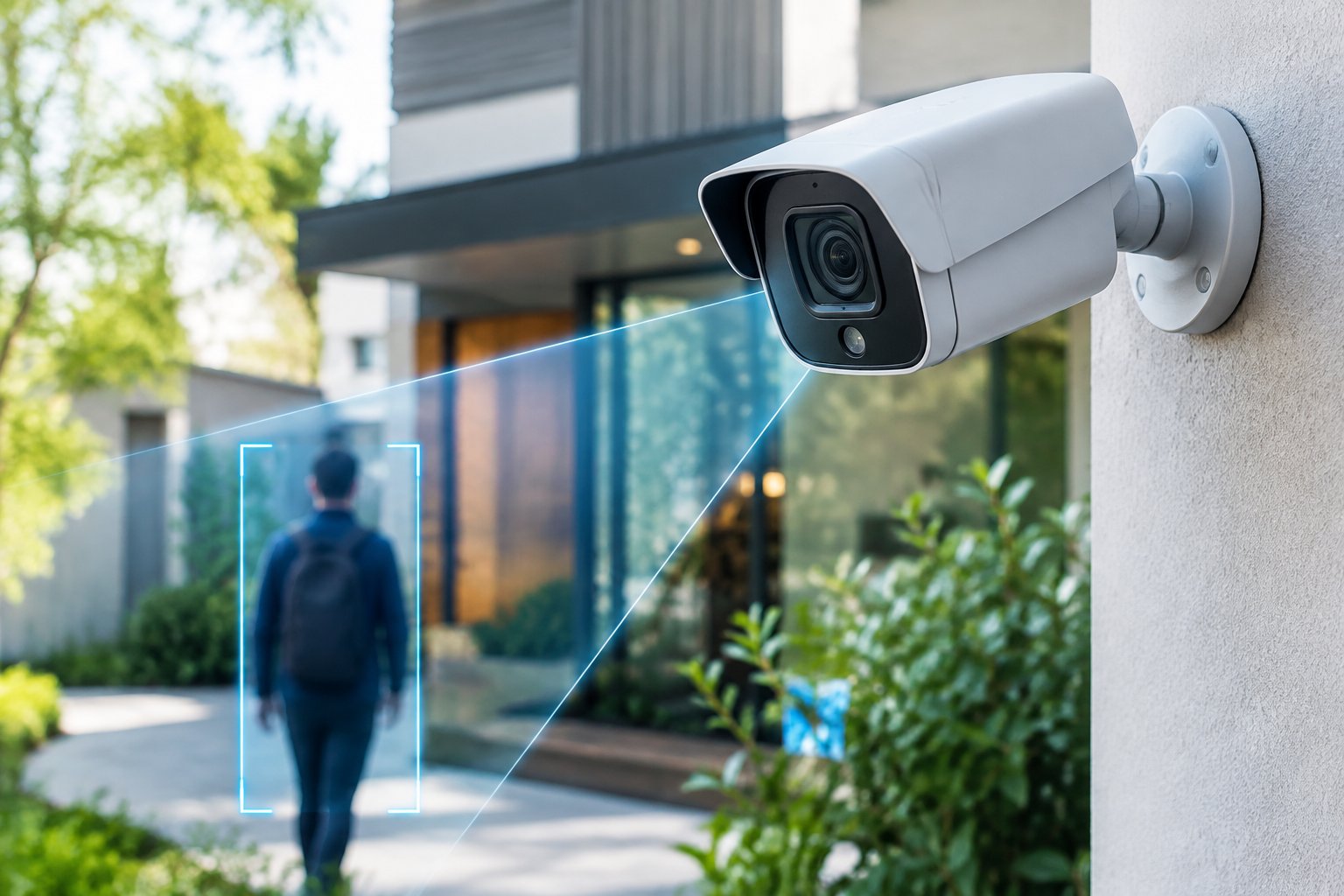
AI security cameras do not have one accuracy score that applies to every task or setting. A system might detect objects, track movement, flag unusual events or compare faces, and each function has different errors and testing needs. Lighting, weather, occlusion and camera angle can also affect performance. To judge a system, look for evidence about the specific feature and the conditions in which it was evaluated—not a broad claim that the camera is “accurate.”
Why there is no single accuracy number
“AI security camera” describes a system that can perform several different kinds of analysis. A recent survey of intelligent video surveillance groups functions such as object detection, motion tracking, abnormal-event detection, vehicle and traffic monitoring, object counting and coordination across cameras. Its review covers research published from January 2000 through July 2025.
These functions answer different questions. Object detection asks whether a system detects an object in an image. Tracking concerns following movement across video. An abnormal-event alert depends on how the system defines an event. Face recognition compares faces or searches for a match. A result for one task cannot establish how well the same camera—or another system—performs a different task.
There is also a difference between a model and a deployed system. The survey describes systems with a data-acquisition layer, a network and transmission layer, and a processing and analytics layer. Processing may be performed at the edge or in the cloud. Errors or constraints at different points in this chain can matter to the outcome, so a test of an algorithm alone may not answer how the complete installation performs.
What camera accuracy means in practice
For everyday use, it helps to ask what the system gets wrong, not only how often it is described as correct. The surveillance survey identifies false alarms, missed detections and misclassifications as reliability problems. These are not interchangeable:
- A false alert is an alert for an event or object that did not meet the system’s intended trigger.
- A missed detection occurs when the system fails to detect something it was intended to detect.
- A misclassification occurs when the system assigns the wrong category.
These distinctions are practical, not merely technical. A system that produces unwanted alerts may demand more human review; one that misses events may not provide the expected warning. Which error matters most depends on the intended use. A single overall percentage can hide that trade-off unless the test explains what was counted and how.
Conditions matter too. The survey identifies lighting changes, weather, occlusion and camera angles as factors that can challenge reliability. A reported result under one set of conditions does not establish performance under all others. Ask whether the evaluation conditions resemble the intended installation, and whether the system was assessed as a complete setup or only as an isolated analytics component.
Face recognition needs separate scrutiny
Face recognition is a particularly important case because a false match can associate the wrong people, while a missed match can fail to associate images of the same person. The National Institute of Standards and Technology’s Face Recognition Technology Evaluation demographics page reports on these two kinds of errors: false positive and false negative differentials. Its summary table was last updated on March 5, 2025.
NIST describes false negatives as strongly dependent on image quality. It gives inadequate lighting or exposure and camera pitch-angle variation as examples that can raise false-negative rates. The page also reports that false-positive differences between demographic groups can occur even with good-quality images, and discusses how training data may be a factor. These findings are about face-recognition algorithms and the evaluation conditions described by NIST; they are not an accuracy rating for object detection, motion tracking or every camera using AI.
The distinction between a one-to-one comparison and a one-to-many search matters as well. The NIST page explains that some one-to-many systems may use repeated one-to-one comparisons, but not all do; performance effects therefore need to be measured in the relevant one-to-many test. A result from one kind of evaluation should not automatically be applied to another.
Demographic performance deserves attention alongside an overall score. A result averaged across groups can obscure differences between them. NIST’s material describes demographic differentials by age, sex and race, and notes that the importance of false-positive versus false-negative differences depends on the application. That makes the use case and the system’s threshold part of interpreting a result—not details to ignore.
What published claims can—and cannot—show
Performance claims are only useful when their scope is clear. Look for the task tested, the population or image data used, the test conditions, the type of error measured and whether results relate to a stand-alone algorithm or a deployed system. The surveillance survey notes a lack of standard evaluation benchmarks, data-annotation protocols and performance metrics across the field. It also identifies a need for stronger evaluation in real-world scenarios. That makes it difficult to compare results when systems are tested using different methods.
A regulatory example illustrates why evidence behind a claim matters. In a December 2, 2024 announcement, the US Federal Trade Commission said it was taking action over alleged unsupported or misleading claims about a company’s facial-recognition accuracy, demographic bias and anti-spoofing performance. The announcement described a proposed consent order and said the Commission would decide whether to make it final after a public-comment period. It is a specific case about allegations and a proposed settlement—not evidence that all camera vendors make unsupported claims or that all AI camera analytics perform poorly.
The practical lesson is to ask for substantiation that matches the claim. A claim that a system is accurate across conditions or groups needs evidence that actually evaluates those conditions or groups. A general claim, or a result from an unrelated task, does not fill that gap.
Questions to ask before relying on an AI camera
- Which exact function is being evaluated—object detection, tracking, event detection, face recognition or another task?
- What errors are measured? Ask whether results distinguish false alerts, missed detections and misclassifications.
- What were the test conditions? Check whether lighting, weather, occlusion and camera angle were considered.
- Does the evidence cover the complete deployed system, including its camera and processing setup, or only an algorithm in isolation?
- For face recognition, are false-positive and false-negative results reported separately, and are demographic differences assessed?
- If the system performs a one-to-many search, was that search evaluated as such rather than inferred from one-to-one results?
- What limitations does the provider disclose, and what human review is expected when an alert or match occurs?
These questions do not guarantee that a system will perform as expected. They help establish what the evidence covers and where it stops. If the provider cannot explain how an accuracy claim was measured, treat the claim as unverified for the conditions and task you care about.
Accuracy is only one part of deployment risk
Even a technically useful alert has implications for privacy and system security. The surveillance survey identifies privacy concerns involving data protection, consent and misuse of personal information. It also identifies cybersecurity risks such as weak encryption, unauthorized access and video-feed tampering. These concerns are separate from whether the analytics correctly identify an object or event, but they affect whether a deployment is trustworthy.
The survey notes that privacy-preserving approaches, including anonymization and federated learning, remain underexplored in the research it reviewed. That is not proof that a particular system lacks safeguards. It is a reason to ask how video is processed, what privacy measures are in place and how access to the system is protected. The appropriate requirements depend on the deployment and jurisdiction; the sources discussed here do not establish a single legal rule for every location.
For a homeowner or small business, the measured question is not simply “Is this camera accurate?” It is “How well does this specific feature work in conditions like mine, what kinds of errors remain, and what happens when the system is wrong?” Accuracy evidence can inform that decision, but it should be read alongside the system’s limits, privacy implications and security practices.
Frequently asked questions
Questions and answers
Are AI security cameras accurate?
There is no single answer for every camera or feature. Performance depends on the analytics task, the conditions in which it operates and how it was evaluated. The surveillance survey identifies false alarms, missed detections, misclassifications and environmental conditions as reliability concerns.
Does a high face-recognition score prove a camera is accurate at detecting events?
No. Face recognition and event detection are different tasks. NIST’s face-recognition evaluation measures face-matching errors under specified conditions; it does not establish the performance of other video analytics.
Can lighting or camera angle affect results?
The surveillance survey identifies lighting changes and camera angles among conditions that can affect system reliability. NIST also describes image quality and pitch-angle variation as relevant to false-negative effects in face recognition.
What should I do with an AI-generated alert?
The sources establish that false alarms, missed detections and misclassifications are possible. They do not establish that an alert alone confirms an event. Treat the alert as something to assess against the system’s stated function and limits.