
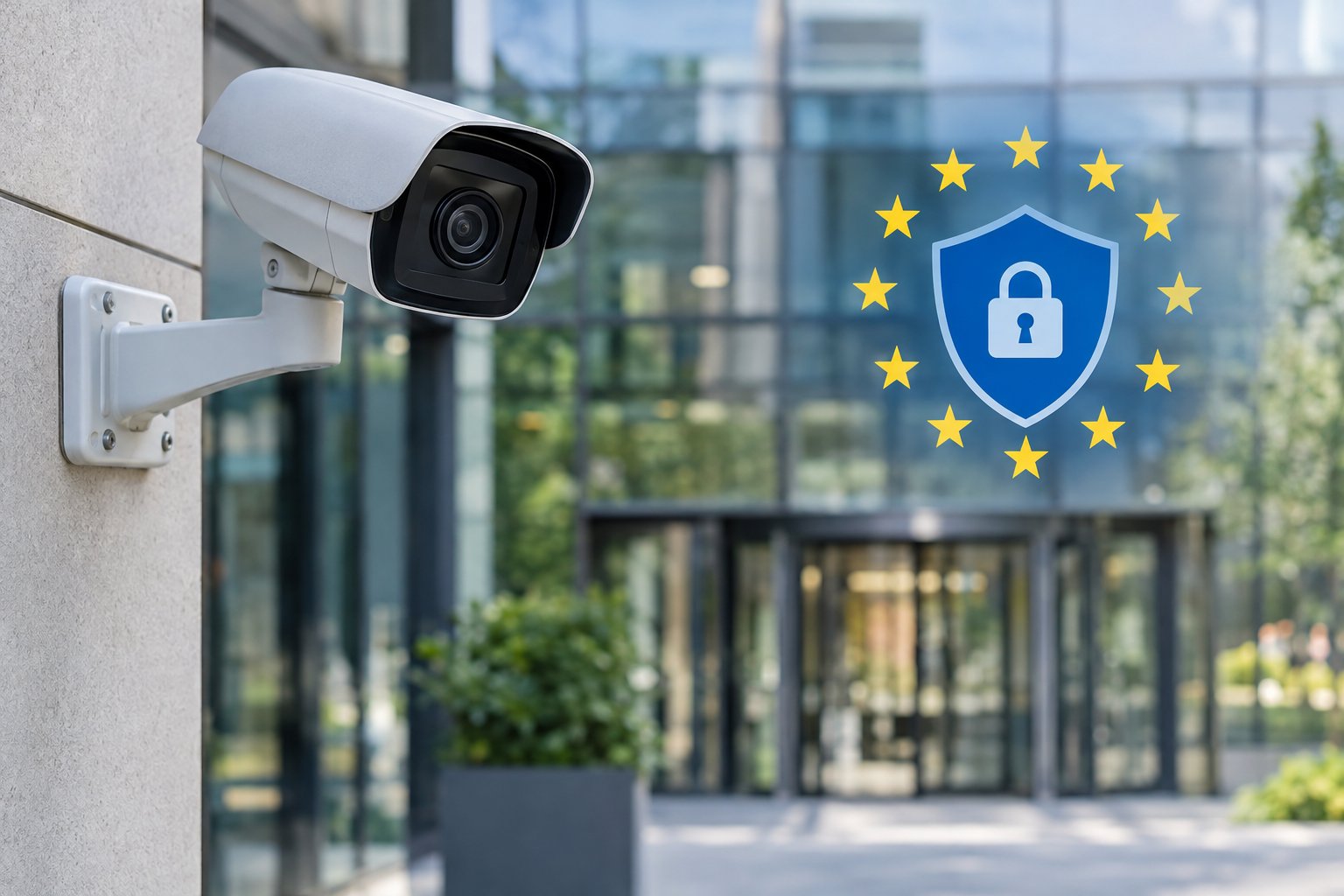
GDPR rules for CCTV cameras are not a single configuration preset. Before installation, define why you need the cameras, check the legal basis and necessity of recording, decide how footage will be secured and retained, and plan how people will be informed. The details depend on the country and the setting: the Irish Data Protection Commission (DPC) provides CCTV guidance for data controllers, while the French CNIL describes additional rules for cameras filming public roads and places open to the public. This is practical guidance, not legal advice.
1. Define the purpose before installing cameras
Start by stating what each camera is meant to achieve. The Irish DPC asks organisations considering CCTV to identify a clearly defined purpose. It also asks whether recording is necessary for that purpose and, where CCTV is used for purposes beyond security, whether those other uses are proportionate. In this context, proportionality means considering whether the extent of recording is appropriate for the stated purpose.
Make the purpose specific enough to guide installation and later decisions. For example, write down which area needs protection and what the system is intended to help address. Then use that statement as a check when choosing camera views, recording schedules and who can access footage. These configuration decisions should serve the purpose you identified, rather than quietly expanding it.
The DPC says a Data Protection Impact Assessment (DPIA) may be needed to assess necessity and proportionality adequately. Its guidance does not say that every CCTV setup automatically requires one. Check the circumstances of your installation and the applicable regulator’s current guidance.
2. Check the legal basis and scope
The Irish DPC identifies the legal basis under Article 6 GDPR as a question to resolve before installing CCTV. Do not treat the presence of a camera, an NVR (network video recorder) or a VMS (video management system) as proof that recording is lawful. Those are system components; they do not, by themselves, establish the purpose or legal basis for processing footage.
Footage or images containing identifiable individuals captured by CCTV are personal data for the purposes of data protection law, according to the DPC. This matters when planning the whole recording path: the camera captures images, and the system may store or make those images available for later viewing. Consider who may be captured and who needs access to the recordings.
The European Data Protection Board (EDPB) publishes Guidelines 3/2019 on video devices. Use that document as an EU-level reference, alongside the national regulator relevant to your location. The DPC and CNIL materials illustrate why a reader should not assume that a camera placement allowed in one situation is allowed everywhere.
3. Check camera views before recording
Camera position, direction and image detail affect what people’s privacy may be exposed to. Treat the view as an important part of the system’s configuration: check what is inside the frame, not only whether the camera covers the intended area. If a view includes places or people beyond the purpose you defined, revisit the position or framing before enabling recording.
National rules can be more specific. In France, the CNIL says private individuals may film only the inside of their own property and may not film a public road, even to protect a vehicle parked outside their home. The CNIL also says cameras must not make it possible to see inside residential buildings or their entrances, and recommends irreversible masking of those areas. These are France-specific details, not a universal summary of every country’s CCTV rules.
For an installation in another country, check the applicable national regulator’s guidance before settling the camera views. If the system records a workplace, the DPC advises that a CCTV data protection policy relating to the workplace should be brought to employees’ attention.
4. Plan storage, access and retention
The DPC asks data controllers to consider how recordings will be stored safely and securely, and how long they will be kept. Its guidance says footage should not be retained for longer than necessary for the original purpose. That is a purpose-based test, not a universal number of days that can be applied to every camera system.
For an NVR or VMS setup, make retention an explicit configuration decision. Set a period that you can explain in relation to the stated purpose, then check that the system is not keeping footage beyond it. The available guidance does not prescribe a particular NVR, VMS, storage device or technical security setting. The practical task is to make sure your chosen system can support the retention and access arrangements you have decided on.
Limit viewing and handling of recordings to the people who need access for the system’s purpose. The DPC specifically asks controllers to consider security arrangements for CCTV footage and the third parties to whom it may be disclosed. Include those questions in your setup plan: who can view footage, how it is protected, and whether it may be shared with anyone else.
French public-space video-protection systems have a separate, jurisdiction-specific retention rule in the CNIL guidance: the period is specified in the prefectural authorisation and cannot exceed one month. The CNIL also says retention should correspond to the system’s purpose and that a few days are generally enough for checks, for example after an incident. Do not apply this French rule as a general GDPR retention period for other locations or types of CCTV.
5. Tell people what the system does
Transparency is part of the setup, not an afterthought. The DPC says people whose images are recorded must be able to access information about the controller’s identity and contact details; the data protection officer’s contact details, if one has been appointed; the purpose and legal basis; any third parties who may receive footage; security arrangements; the retention period; data subject rights; and the right to complain to the DPC.
Decide how that information will be made available before recording begins. The DPC says a CCTV data protection policy is best practice and may be published on an official website to inform members of the public who attend the premises. For a workplace policy, it says employees should be made aware of it. These practical steps help connect the information people receive to the actual operation of the system.
For French public-space video-protection systems, the CNIL says people must be informed using signs or panels displayed permanently, visibly and in a way people can understand. Its guidance describes a two-level approach to information. Those details belong to the French framework; check local requirements for other jurisdictions.
6. Use a pre-installation checklist
Work through these decisions before recording
- Write down the purpose
State what each camera is intended to achieve. Check that each camera view and recording choice serves that purpose.
- Check the legal basis and necessity
Identify the legal basis under Article 6 GDPR for your use of CCTV. Consider whether recording is necessary and whether any non-security purpose is proportionate.
- Review the camera view
Check what the camera captures and whether the view extends beyond the purpose. Look up national rules for property boundaries, public areas and workplaces.
- Set storage and access arrangements
Decide how recordings will be stored securely, who can access them, whether they may be disclosed to third parties, and how long they are needed for the stated purpose.
- Prepare information for people recorded
Make the required information available, including the purpose, legal basis, retention period and relevant contact details. Consider whether a CCTV policy is appropriate for your setting.
- Check whether a DPIA may be needed
The DPC says a Data Protection Impact Assessment may be needed to assess necessity and proportionality. Check the guidance that applies to your situation.
What changes for domestic CCTV?
Domestic CCTV can have legitimate uses, including security, health and safety, and preventing or detecting crime. It can also raise privacy and data protection concerns for people recorded. The Irish DPC provides separate guidance on domestic CCTV, intended to help people understand their rights and outline system operators’ obligations under GDPR.
Do not assume that calling a system “domestic” settles which rules apply. Check the guidance for your location and how the camera is used, particularly if it captures people outside the immediate intended area. The CNIL’s France-specific guidance, for example, says individuals may film only inside their property and not the public road.
Which rules should you check first?
Common setup questions
Does GDPR set one standard retention period for every CCTV system?
The Irish DPC says footage should be kept no longer than necessary for the original purpose. The cited guidance does not give one general period for every system. The CNIL’s maximum of one month applies to the French public-space video-protection systems described in its guidance, not to every CCTV installation.
What should a CCTV notice or policy explain?
The Irish DPC says people must be able to access information including the controller’s identity and contact details, the purpose and legal basis, possible recipients, security arrangements, the retention period and relevant rights. It also identifies a CCTV data protection policy as best practice.
Can a home camera film a public road?
The CNIL says individuals in France may film only the inside of their property and may not film the public road. Check the rules that apply in your own country rather than treating this France-specific guidance as universal.
Does every CCTV installation need a DPIA?
The Irish DPC says a Data Protection Impact Assessment may be needed to assess necessity and proportionality. Its guidance does not say that every installation automatically requires one.
Keep the legal check tied to the system
A CCTV setup is easier to assess when its purpose, camera views, storage settings, access arrangements and public information all describe the same use. If one of those changes, review whether the original purpose and arrangements still fit. For legal requirements, use the EDPB’s video-device guidelines alongside the current guidance from the regulator for your country and situation.
For Ireland, consult the DPC guidance on CCTV. For France, the CNIL guidance on video protection explains rules for the settings it covers. These materials have different scopes, so use the one relevant to your installation rather than combining jurisdiction-specific rules into a single checklist.