
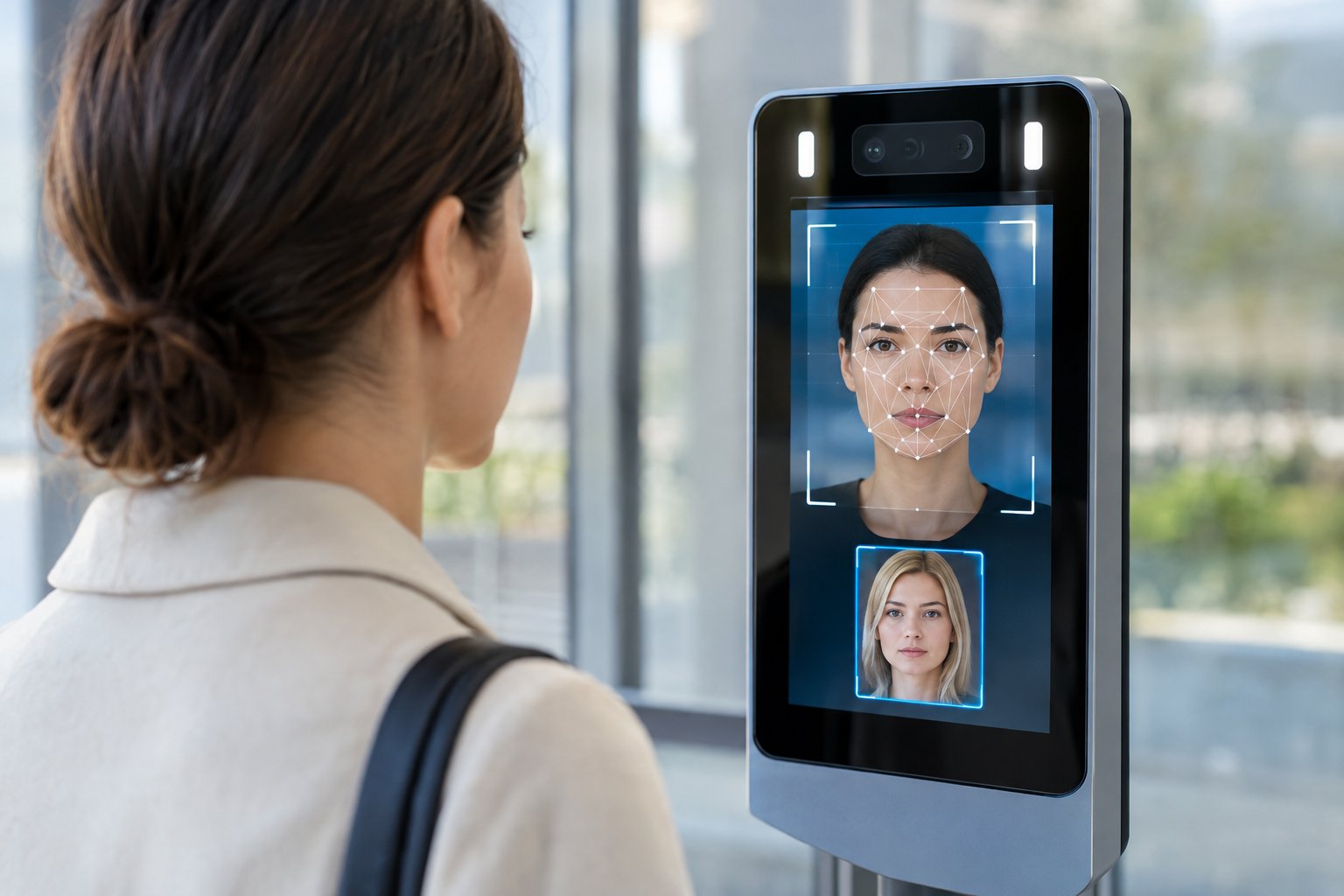
Sumsub and Constructor University’s Bayes Group have announced ALADDIN, a generative AI model designed to create realistic face swaps using fewer neural-network evaluations than a leading diffusion-based approach. In a report published on November 13, 2026, Biometric Update said the organizations developed the model to test biometric identity verification defenses. The reported research concerns image-based face swapping; it does not demonstrate an end-to-end live video injection attack against a verification system.
What the model does
ALADDIN stands for Adversarial LAtent Diffusion Distillation for One-Step Identity SwappiNg. Biometric Update reported that the team began with a high-capacity diffusion model, which generates images through multiple passes, then used distillation to compress that process into a single operation. The model transfers a source identity onto a target image while retaining details such as pose, expression, lighting, background and partial obstructions to the face.
The reported efficiency comparison is with a leading diffusion-based approach: ALADDIN reaches what its developers describe as top diffusion-level realism in one network evaluation instead of 28. Sumsub says the one-step process reduces the time required for its red-team simulations—from days to hours. Red-teaming here means testing an organization’s own defenses by simulating attacks.
in a single network evaluation instead of 28.
Why the research matters to verification teams
For organizations that use face biometrics, the stated purpose is to make defensive testing faster. Sumsub co-founder and CTO Vyacheslav Zholudev said the model could help the company simulate complex edge cases and strengthen its liveness defenses before new threats reach production. Liveness checks aim to distinguish a live person from a presentation or simulated image, but the report notes that live face swaps may turn, blink and speak on cue and can be fed through a virtual camera.
Biometric Update also described limitations in current face-swap tools: they can struggle with head angles, eyewear, harsh lighting and age differences between an identity document photo and a live face. These details matter to system operators because a model’s results in controlled image evaluations do not, by themselves, establish how it will perform across real deployments or conditions.
The scale of the concern is presented through figures attributed to other organizations. Biometric Update reported that Sumsub found sophisticated identity fraud had grown 180 percent in a year; iProov reported a 300 percent rise in face-swap attacks; and Group-IB counted roughly 33 injection attack attempts per day against one financial institution. These are separate reported findings, not measurements of ALADDIN’s performance.
Scope, release and risks
A key boundary is the type of evidence: the research evaluates image-based face swapping. Biometric Update explicitly notes that it does not demonstrate an end-to-end live video injection attack against an identity verification system. Readers should therefore distinguish the model’s reported image-generation result from proof that it can defeat a particular deployed service.
The researchers also questioned how face-swap systems have been benchmarked. According to Biometric Update, they re-evaluated existing methods using an independent scoring framework after identifying that some academic evaluations favored methods scored by the same models used to train them. The team argues that its approach offers a fairer basis for comparing generation speed and image quality.
The paper has been accepted for presentation at the IEEE/CVF Winter Conference on Applications of Computer Vision (WACV) 2027. The research code is public on Hugging Face alongside an open classifier intended to detect ALADDIN-generated images. Model weights, however, are available through a gated application process for legitimate academic and defensive research.
That staged release reflects a dual-use concern reported by Biometric Update: greater efficiency may help defenders run more tests, but it could also make sophisticated face swaps cheaper for attackers. For teams responsible for identity checks, the practical implication is to assess defenses in their own deployment conditions and consider both biometric presentation attacks and injection attacks. ALADDIN’s reported results are not a substitute for evaluating those defenses directly.
What to watch next
The next stated milestone is the paper’s presentation at WACV 2027. Readers following the research can also distinguish the publicly available code and classifier from the model weights, which remain subject to an application process. For operators, the central issue is whether defensive tests cover the conditions their systems face, including image quality and possible video injection—not whether a model performs well on images alone.
Source: biometricupdate.com