
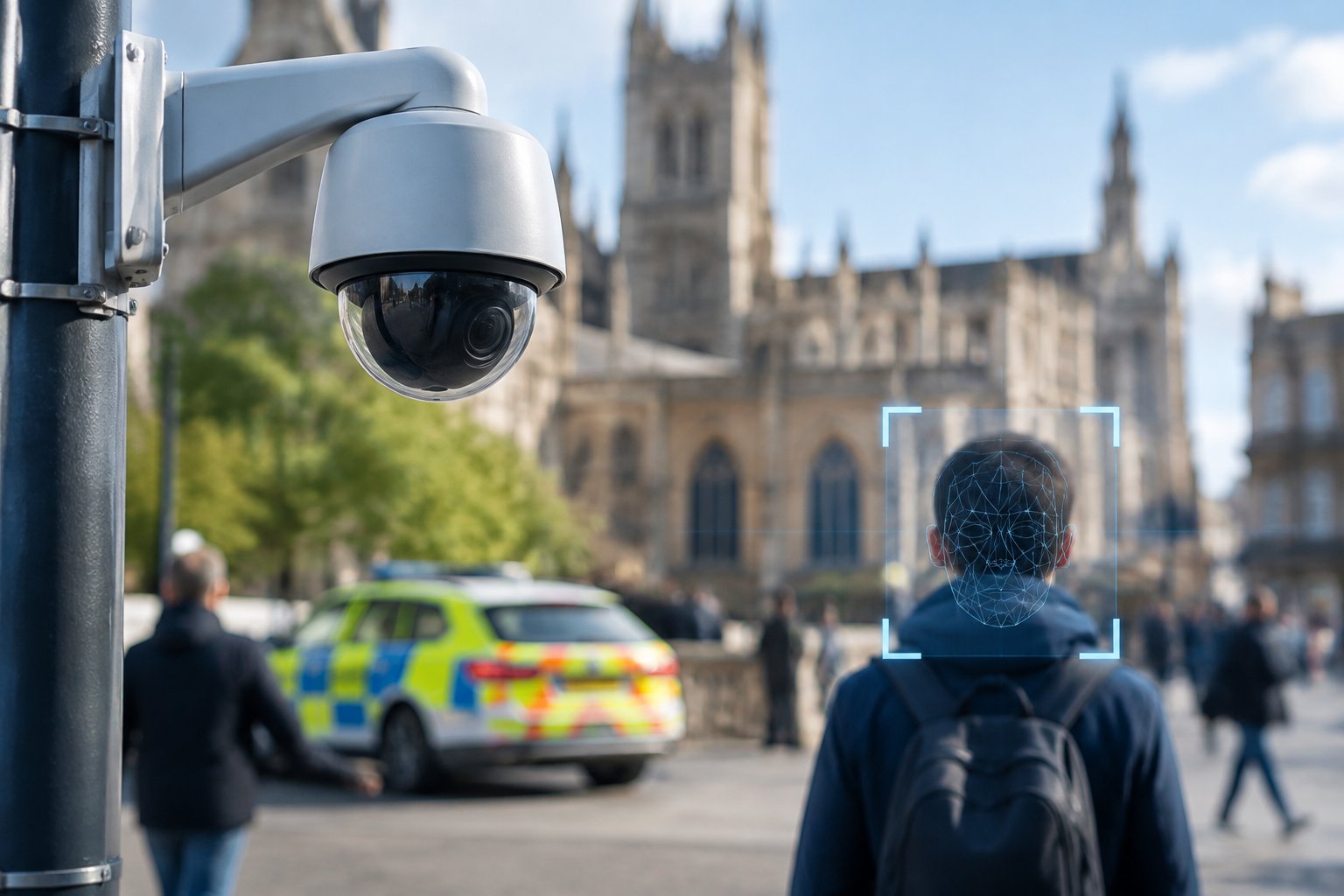
Avon and Somerset Police plans to begin using live facial recognition (LFR) in Bath on Wednesday, November 25, subject to final operational authorisation. The force announced the planned deployment on November 5 and says it will use equipment and expertise from South Wales Police for the initial operation. Details including the times and deployment area are due to be published in advance.
What the police have announced
According to Avon and Somerset Police, the Bath operation is intended as an initial deployment while the force develops its own capability. South Wales Police will provide the equipment and operational experience; Avon and Somerset officers will be present and engaging with the public.
The force describes LFR as an overt policing capability for use in crowded public spaces. Live CCTV images are compared, on a closed network, with a pre-authorised watchlist created for that particular deployment and its stated policing objectives. The force says watchlists can include people wanted by the courts, suspected of serious offences, or considered to pose an immediate risk of harm to themselves or others.
A system alert is a possible match, not a decision to take action. The police say trained officers review alerts and may make further checks before deciding whether any action is needed. “The technology does not make decisions by itself,” the force said.
As with any policing power or tactic, it will only be used where it is lawful, necessary and proportionate to do so.
The MNR Journal and the West Somerset Free Press also reported the planned Bath date and the conditions attached to it. Their reports say marked police vehicles will be used, signs will be placed outside the “Zone of Recognition,” and officers will be on hand to answer questions. Those are the details the force has given about how people will be alerted to the operation; the exact area and timings are still to be announced.
What it means for people in the area
Anyone who passes through the eventual recognition zone could have their face captured by the live CCTV cameras and compared with the operation’s watchlist. The police say facial images that do not match someone on the list are automatically and permanently deleted. They also say each deployment’s watchlist is deleted afterward, in line with force policy and national guidance.
For people choosing, operating or following video systems, the distinction between an automated alert and a human decision matters: the force says officers assess possible matches rather than leaving the system to decide what happens. The announcement does not provide performance figures or describe the possible consequences of a false alert, so it does not establish how often the system may produce a possible match that officers do not confirm.
The force says its use of LFR is subject to legal, data-protection and equality safeguards, including senior-officer authorisation for every deployment and detailed assessments. It says deployments will be signposted and subject to governance and oversight. These are the safeguards the force has announced; the planned operation remains subject to final authorisation.
Background and oversight
Avon and Somerset Police says the introduction follows engagement led by the Office of the Police and Crime Commissioner with community representatives, academics and residents from across the force area. The stated purpose was to inform scrutiny and oversight arrangements. Police and Crime Commissioner Clare Moody said she would monitor police use of the technology closely; the force’s announcement also says she brought together community leaders, academics, experts and residents to discuss its governance and scrutiny.
The police present LFR as a watchlist-matching tool for crowded public places. Inspector Stuart King said it could help locate wanted individuals more quickly, safeguard vulnerable people and prevent harm. Those are the force’s stated aims, not reported results from the planned Bath deployment.
The system’s use of facial imagery in public raises questions about privacy and civil liberties. The police acknowledge that people may have concerns and say they will publish information about deployments, safeguards and outcomes where operationally appropriate. The announcement does not give the Bath watchlist, the number of people expected to be captured, or details of any outcome measures.
What to check next
Before the planned November 25 operation, the force says it will publish the deployment timings and area. Those details will help people in Bath establish whether their route could pass through the Zone of Recognition. The date is not unconditional: the first deployment remains subject to final operational authorisation.
People with questions during the operation can speak to officers, who the force says will be present. Afterward, the police say information about deployment safeguards and outcomes will be published where operationally appropriate. The Police and Crime Commissioner has separately said she will monitor the force’s use of LFR.
Source: avonandsomerset.police.uk