
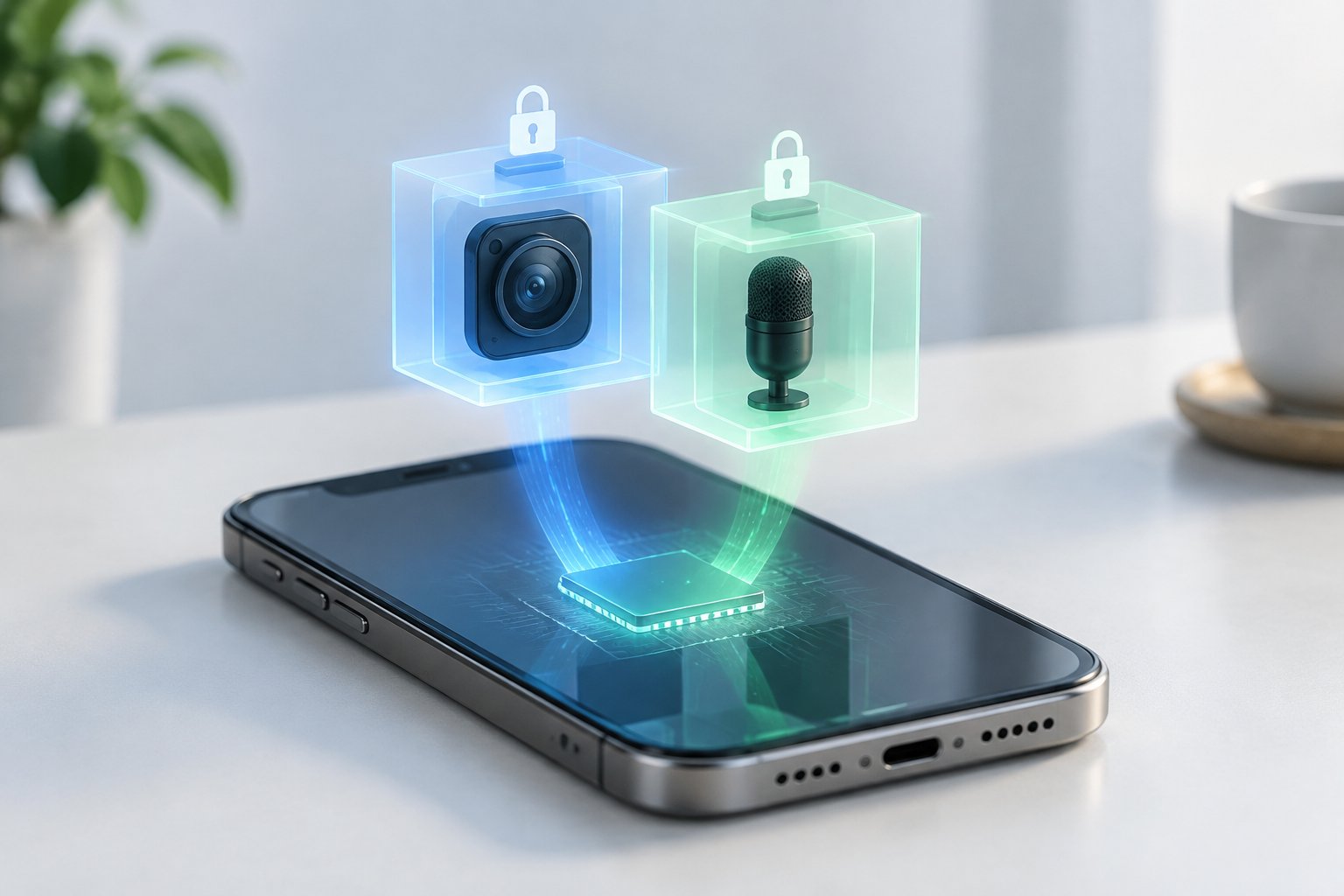
Apple has published details of Secure Exclaves, an architecture designed to protect camera and microphone data during background processing. In a report dated November 13, 2026, Help Net Security reported that Apple says information processed and analyzed inside an Exclave cannot be accessed by the main operating system, apps or Apple itself.
What Apple says the architecture does
Apple uses Secure Exclaves for person recognition on HomeView, as well as for Siri Recap and Live Rewind, according to Help Net Security. The architecture also protects the on-screen camera and microphone indicators on iPhone 18 Pro, iPhone 18 Pro Max and iPhone Duo, and camera indicators on MacBook Neo and HomeView.
The system is designed for background or “ambient” sensing: using a microphone or camera to interpret the surroundings and recognize an enrolled user’s voice or face. Apple says this processing reduces sensor streams to simple signals, such as whether a particular sound was detected or an enrolled user was recognized. During ambient sensing, raw audio and video stay inside Secure Exclaves and are discarded when processing finishes, rather than being passed to the main operating system.
Apple describes a second, active mode. Sensors respond to particular environmental triggers in ambient mode, and only specified metadata may be shared with the rest of the system. In active mode, full sensor data can be released to the main operating system, with a secure indicator intended to tell the user that this is happening.
How the boundary and indicator work
Apple built the isolated environment around three requirements: the main operating system must not be able to extract or modify data processed in an Exclave; a controlled interface must restrict what information crosses the boundary; and users must be able to see when an active sensor session is underway. These are descriptions of the architecture’s intended protections, as reported by Help Net Security.
The Exclaves run in a separate processor execution context with an independent operating system. A component called the Secure Page Table Monitor, or SPTM, runs at a higher privilege level than the main operating system’s kernel and enforces memory isolation. Exclaves communicate with the rest of the system through Secure IPC. Apple audits each interface to the main operating system to limit outgoing information to metadata needed for ambient sensing.
For active sessions, the Exclave Indicator Controller allows full sensor data to flow to the main operating system only after confirming that the indicator is on and has been visible long enough. On HomeView, it controls the LED directly and checks that it is bright enough to be seen. On iPhone, a display Exclave checks that the pixels rendering the indicator meet a minimum brightness threshold and are not obscured by nearby pixels.
HomeView person recognition, step by step
Help Net Security reported Apple’s description of the recognition process as a sequence of isolated tasks:
- At startup, the person-recognition Exclave loads enrolled face and voice models and an identity database from the secure storage Exclave.
- The camera Exclave detects faces and queues frames for processing. Audio Exclaves handle anomaly detection and echo cancellation. They can notify the main operating system that someone may be present without sharing images or audio.
- A Neural Engine Exclave generates face and voice prints using isolated work queues, then clears its state after each model finishes.
- An orchestration service matches those prints against the identity database and combines the results into a confidence score.
- Only the person’s identifier, position and confidence level are sent to the person-recognition daemon in the main operating system.
Apple says these outputs support identity-dependent features in Calendar, Messages and Apple Music, along with compatible third-party audio and video apps from an iPhone. It says no audio or video leaves Secure Exclaves during recognition.
Why the details matter to camera and streaming readers
For people assessing camera or microphone features, the distinction between ambient and active processing is practical: Apple describes one mode that shares only specific metadata and another that can release full sensor data to the operating system. The indicator is part of that second-mode safeguard. The description also makes clear that recognition can produce an identifier, position and confidence level even when the underlying audio and video remain inside the isolated environment.
That is useful context for understanding what a system says it protects and what information it may still send onward. It does not, by itself, establish how a particular feature behaves in every setting. Readers considering a device or feature can look for its stated processing mode, what outputs leave the isolated boundary, and how the user is notified when full sensor data is released. Apple’s account, as reported here, concerns the architecture and named uses; it should not be read as a general guarantee about every camera or microphone system.
Technical foundation and what comes next
Apple says Secure Exclaves use a customized version of the L4 microkernel, which it originally built for some of its most security-sensitive deployments, including the Secure Enclave Processor. The microkernel uses capabilities: secure resource handles that identify a resource and authorize access to it. Secure IPC provides communication between Exclaves, while the audited interfaces restrict what metadata can pass to the main operating system.
Apple said it will continue hardening the architecture through AI-accelerated vulnerability research and broader formal verification coverage. Those are the next steps it has announced; Help Net Security did not report a date for them. For readers following camera and microphone privacy, the points to watch are whether Apple provides further technical detail on those efforts and how the described safeguards apply to the named features and devices.
Source: helpnetsecurity.com